Country-Specific Visa Information (8/14)
Applying to teach in Korea requires certain official documents, such as your apostilled National Police Certificate (NPC) and your notarized and apostilled Testamur (Bachelor’s Degree). These steps verify that your documents are authentic and accepted by Korean schools and immigration authorities.
In this guide, we break down the process to get your documents, whether you are in Australia or overseas.
| If you are working with us, please send the original apostilles to us here:
Suite #402, Saimdang-ro 31-gil, Seocho-gu, Seoul, Republic of Korea (06650) (this should only be done after you have signed a contract through us) |
Steps to Get an Apostilled National Police Certificate (NPC)
A National Police Certificate (NPC) is issued by the Australian Federal Police (AFP). Once issued, your NPC must be apostilled by the Department of Foreign Affairs and Trade (DFAT).
To obtain an apostilled National Police Certificate (NPC), there are four main steps:
- Prepare Documents for Your NPC
- Get Your Fingerprints (Only if asked, such as the Ulsan or Suwon Immigration Offices in Korea)
- Obtain Your NPC
- Apostille Your NPC
1. Prepare Documents for Your NPC
Prepare Identification Documents:
Prepare and scan your identification documents. You must provide at least 100 points of identification for your NPC application. Refer to the AFP checklist for the full list of acceptable documents.
Common Primary Documents:
- Australian Passport - 70 Points
- Australian Driver's License - 40 Points
For an Australian Criminal Record Check (CRC), most applicants only need a name-based background check. A fingerprint check is generally not required and is only used in special circumstances, such as for locations like Ulsan or Suwon.
- If a fingerprint check is not needed, we recommend applying online.
- If a fingerprint check is required, you must print and complete the National Police Check Application Form, as fingerprint checks must be submitted by post.
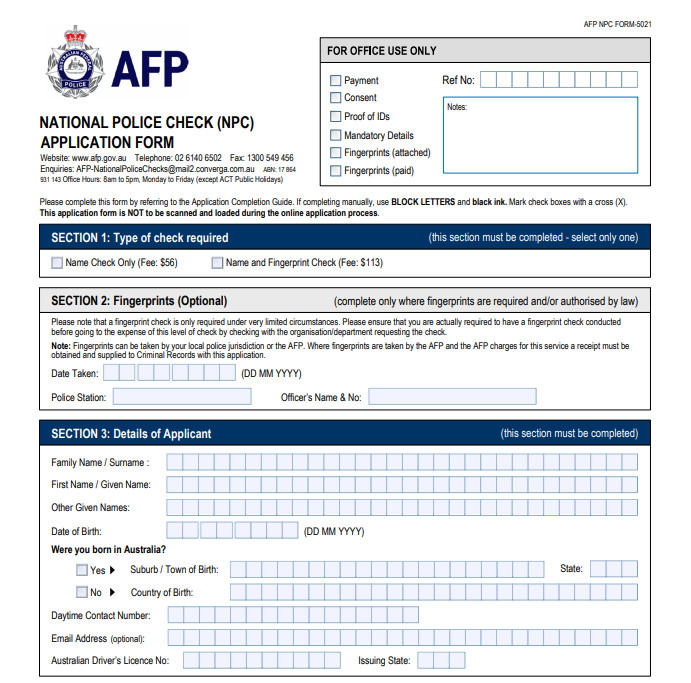
2. Get Your Fingerprints (In-Country)
For an Australian Criminal Record Check (CRC), most applicants only need a name-based background check. A fingerprint-based check is generally not required and is only used in special circumstances, such as for certain locations like Ulsan or Suwon.
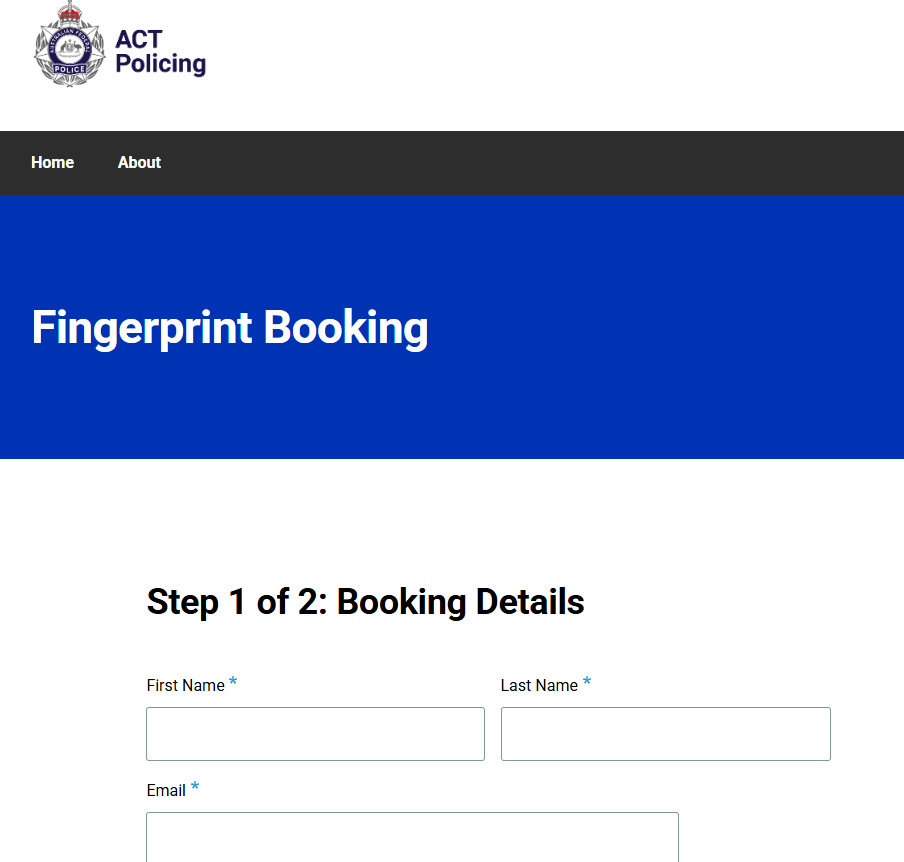
If you live in the Australian Capital Territory (ACT), book a fingerprint appointment through the ACT Policing website. If you live outside Canberra, you can have your fingerprints taken at your local police station.
Get Your Fingerprints (Overseas)
If you are in a foreign country, most local police stations offer fingerprinting services. If the fingerprint form is not in English, you must also provide an official translation when submitting it to the AFP.
3. Obtain Your NPC
Post the original fingerprint form to the AFP along with your identification documents, payment, and completed application form.
| Note: You must send the ATP the form within 3 months of the date you sign it. |
Cost: 56 AUD
Processing Time: 15 ~ 30 business days
Post to:
Australian Federal Police
Criminal Records
Locked Bag 8550
CANBERRA CITY ACT 2601
You will receive both a digital certificate (PDF) and a hard copy sent to your postal address.
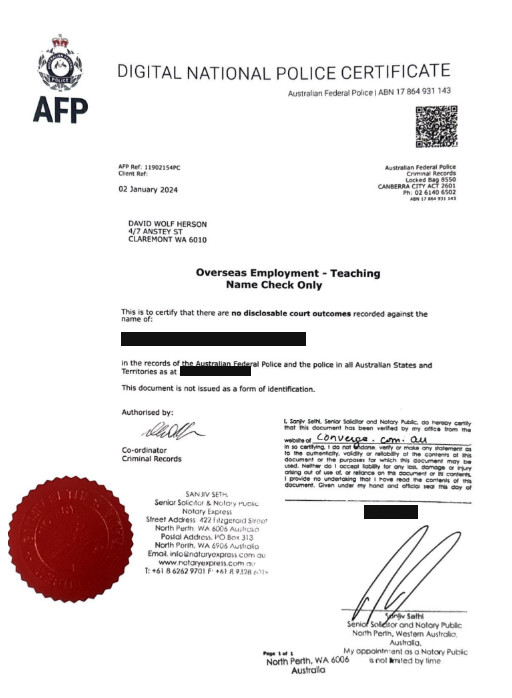
4. Apostille Your NPC
Once your NPC is issued, it must be apostilled by the Department of Foreign Affairs and Trade (DFAT). DFAT provides document legalisation services in Australia (in person or by mail) and overseas through Australian embassies and consulates.
Option 1: Submit in Person
You can lodge your documents at any Australian Passport Office. An appointment is required, and someone may attend on your behalf.
Option 2: Submit by Mail
You may also post your documents to DFAT.
Include the following:
- Your original documents and completed Document Legalisation Request Form
- Credit card authorisation (Section 7 of the request form)
- A self-addressed registered post envelope for the return of your documents
Cost (Apostille or authentication): 102 AUD
Processing time: Varies, and can be longer during peak periods, such as the end of the school year and holiday seasons
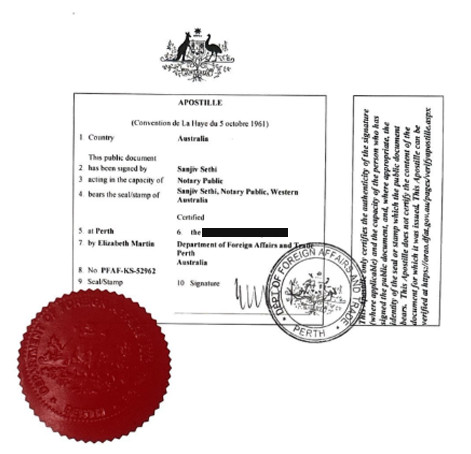
Steps to Get a Notarized and Apostilled Bachelor's Degree
You must submit a notarized copy of your Bachelor’s degree before it can be apostilled from the Department of Foreign Affairs and Trade (DFAT).
To obtain a notarized and apostilled Bachelor's degree, there are two main steps:
- Get an Authenticated Copy of Your Original Testamur
- Signed by an authorised staff member
- Apostille a Copy of Your Diploma
1. Get an Authenticated Copy of Your Original Testamur
You can request an official copy of your original degree from your university. In most cases, the university can arrange for an authorised staff member, such as the central "Student Administration" office, to sign and certify a copy of your original testamur (degree certificate).
Some universities may only re-issue lost or stolen certificates. In this case, you must photocopy your diploma and get it notarised by an Australian Notary Public.
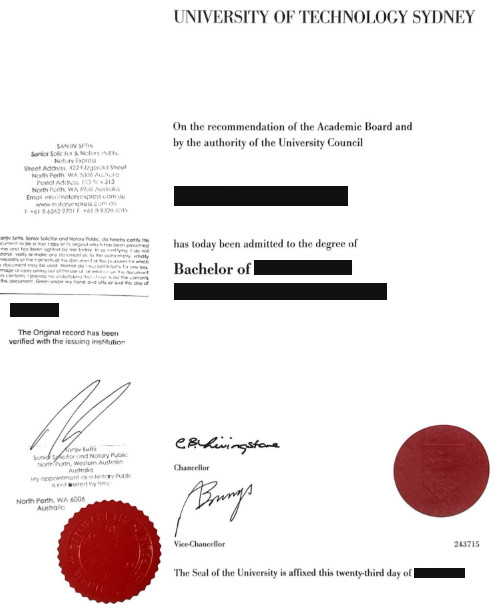
3. Apostille a Copy of Your Testamur
Once your testamur is issued, it must be apostilled by the Department of Foreign Affairs and Trade (DFAT). DFAT provides document legalisation services in Australia (in person or by mail) and overseas through Australian embassies and consulates.
Option 1: Submit in Person
You can lodge your documents at any Australian Passport Office. An appointment is required, and someone may attend on your behalf.
Option 2: Submit by Mail
You may also post your documents to DFAT.
Include the following:
- Your original documents and completed Document Legalisation Request Form
- Credit card authorisation (Section 7 of the request form)
- A self-addressed registered post envelope for the return of your documents
Cost (Apostille or authentication): 102 AUD
Processing time: Varies, and can be longer during peak periods, such as the end of the school year and holiday seasons
FAQ
Q: How long does the entire process take?
|
Processing times can vary, as the Department of Foreign Affairs and Trade (DFAT) does not provide an exact timeframe. Generally, apostille services take around 3 business days, but this may be longer during peak periods such as the end of the school year or holiday seasons. The timeframe for obtaining an authenticated copy of your testamur also depends entirely on your university’s processing speed.
|
Q: Can I send the original diploma?
|
In theory, you can, but we do not recommend it. You will not receive the diploma back once you send it to your school. Always use a copy of your testamur (Bachelor's degree). |
Q: I graduated from an Australian university but am not an Australian citizen. Do I need to notarize and apostille my diploma in Australia?
|
Yes. Even if you are not an Australian citizen, documents issued by an Australian school must be notarized and apostilled in Australia to be recognized abroad. |
Q: I have a Master's degree. Do I also need to get it notarized and apostilled?
|
Unless requested by the school, you do not have to get your Master's degree notarized and apostilled. A Bachelor's degree will suffice if it was issued within one of the seven designated native English-speaking countries (the U.S., U.K., Canada, South Africa, Australia, Ireland, and New Zealand). |
Q: I have a teaching certificate (TEFL, TESOL, CELTA, etc.). Do I also need to get it notarized and apostilled?
|
Unless requested by the school, you do not. For an E-2-1 visa, a teaching certificate is not required. |
Not from Australia? Find out how to apostille and notarize your documents
Share

Embark Recruiting Blogs
Embark Recruiting
As former native English teachers in Korea, we know exactly what it’s like to navigate teaching abroad. That’s why we’re committed to increasing transparency in schools and improving Korea’s ESL teaching industry. At Embark Recruiting, we provide full support to help you succeed. Our blogs offer guidance, tips, and insider knowledge for teaching in Korea.