Country-Specific Visa Information (10/14)
Applying to teach in Korea requires certain official documents, such as your apostilled RCMP Criminal Record Check (CRC) and your notarized and apostilled Bachelor’s Degree. These processes verify that your documents are authentic and accepted by Korean schools and immigration authorities.
In this guide, we break down the process to get your documents, whether you are in Canada or overseas.
| If you are working with us, please send the original apostilles to us here:
Suite #402, Saimdang-ro 31-gil, Seocho-gu, Seoul, Republic of Korea (06650) (this should only be done after you have signed a contract through us) |
Steps to Get an Apostilled RCMP Criminal Record Check (CRC)
A criminal record check issued by the Royal Canadian Mounted Police (RCMP) requires an apostille by a Canadian competent authority.
To obtain an apostilled RCMP Criminal Record Check, there are four main steps:
- Complete the Criminal Real Time Identification Services Forms
- Consent Forms (by accredited fingerprint companies and police agencies)
- Get Your Fingerprints
- Obtain Your RCMP Criminal Record Check
- Apostille Your RCMP Criminal Record Check
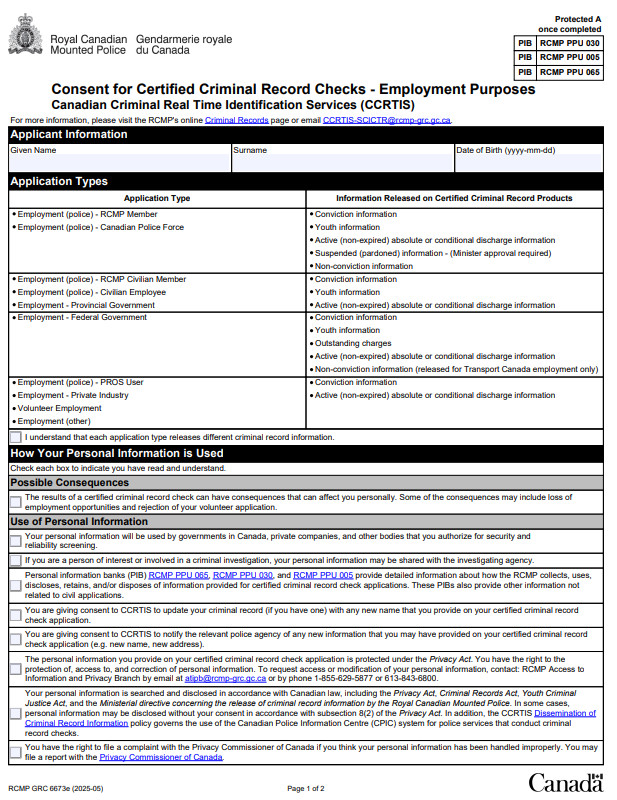
1. Complete the Criminal Real Time Identification Services Forms
Fill out any forms that relate to a certified Criminal Record Check, such as the RCMP's consent forms.
Processing Time: 3 business days (+ postal delivery time)
| Note: If there is a match to a criminal record, it may take 120 business days. |
2. Get Your Fingerprints (In-Country)
Go to your local police department to have your fingerprints taken and to submit your request for a certified criminal record check.
| Note: Some police services may direct you to an accredited fingerprint company instead. |
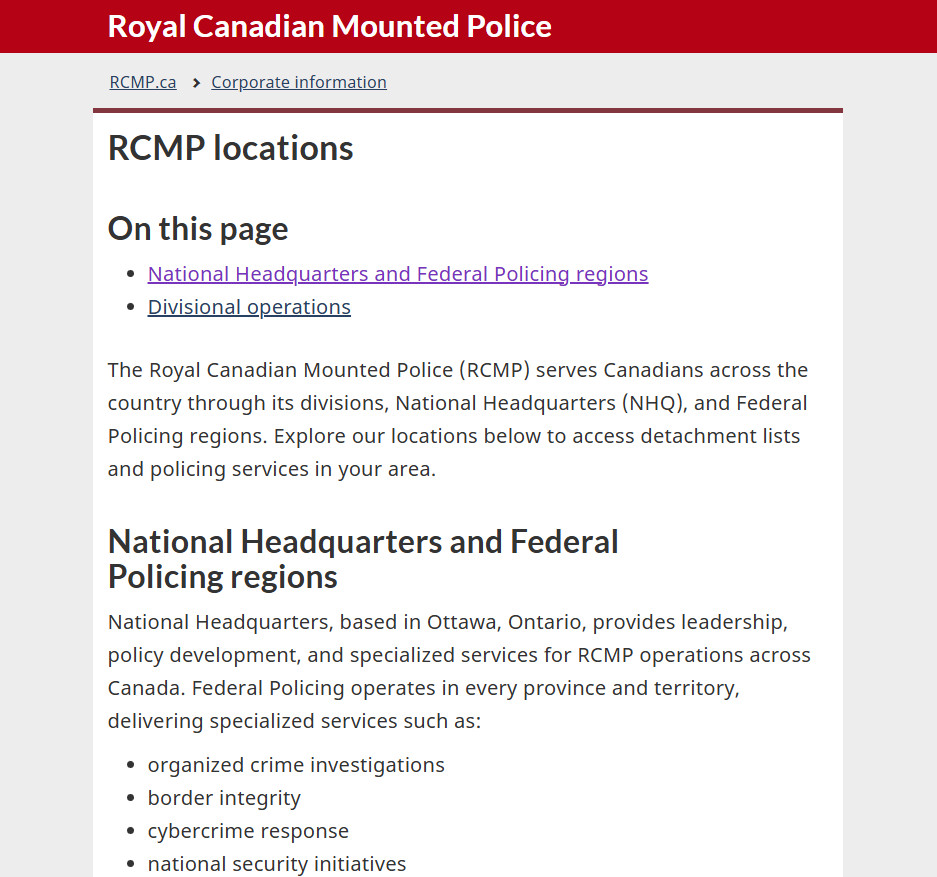
Get Your Fingerprints (Overseas)
If you are in a foreign country, most local police stations offer fingerprinting services, and you can request a paper copy of your fingerprints.
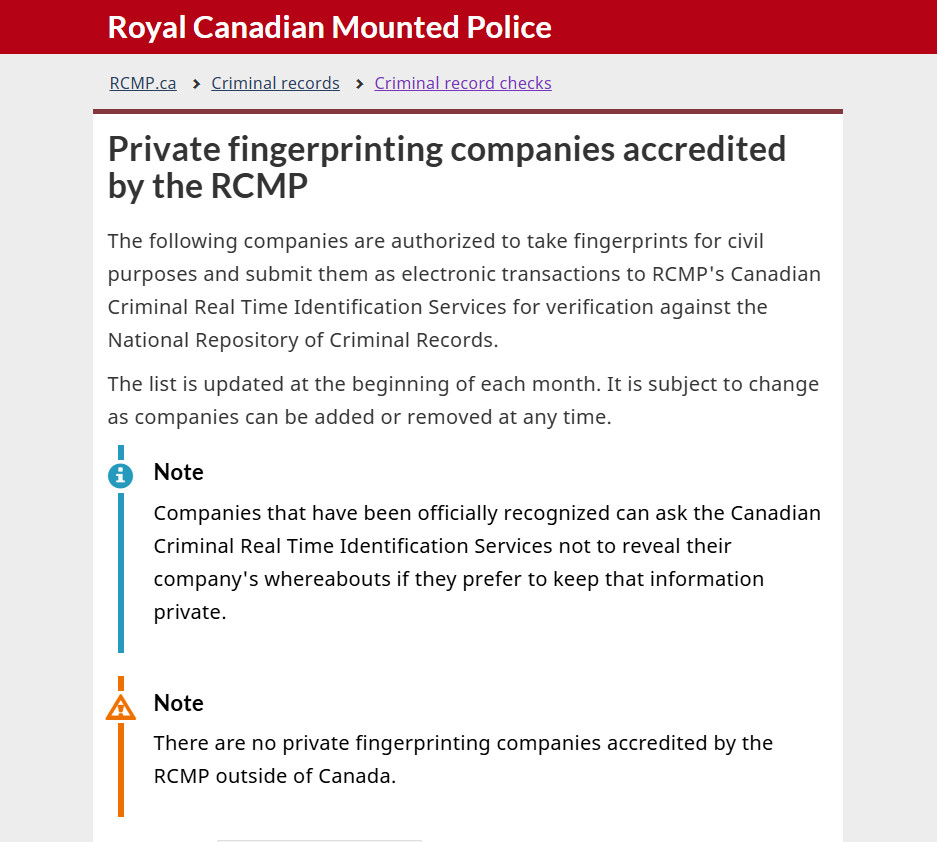
- Contact a fingerprinting provider in Canada that is accredited by the RCMP to complete your application. If you have fingerprints taken on paper, you must use an accredited Canadian company to have them converted into a digital file. That company will then transmit your information electronically to the Canadian Criminal Real Time Identification Services (CCRTIS) on your behalf.
| Note: DO NOT mail these fingerprints or your application directly to the RCMP's CCRTIS. |
3. Obtain Your RCMP Criminal Record Check
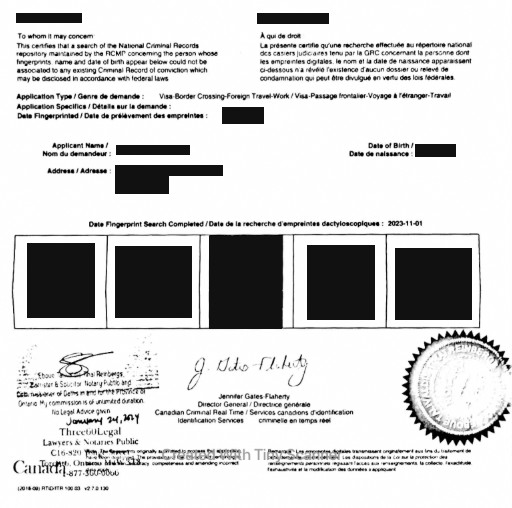
The RCMP Criminal Record Check includes:
- Signature of the Director General of the Canadian Criminal Real Time Identification Services
- Official RCMP dry seal
4. Apostille Your RCMP Criminal Record Check
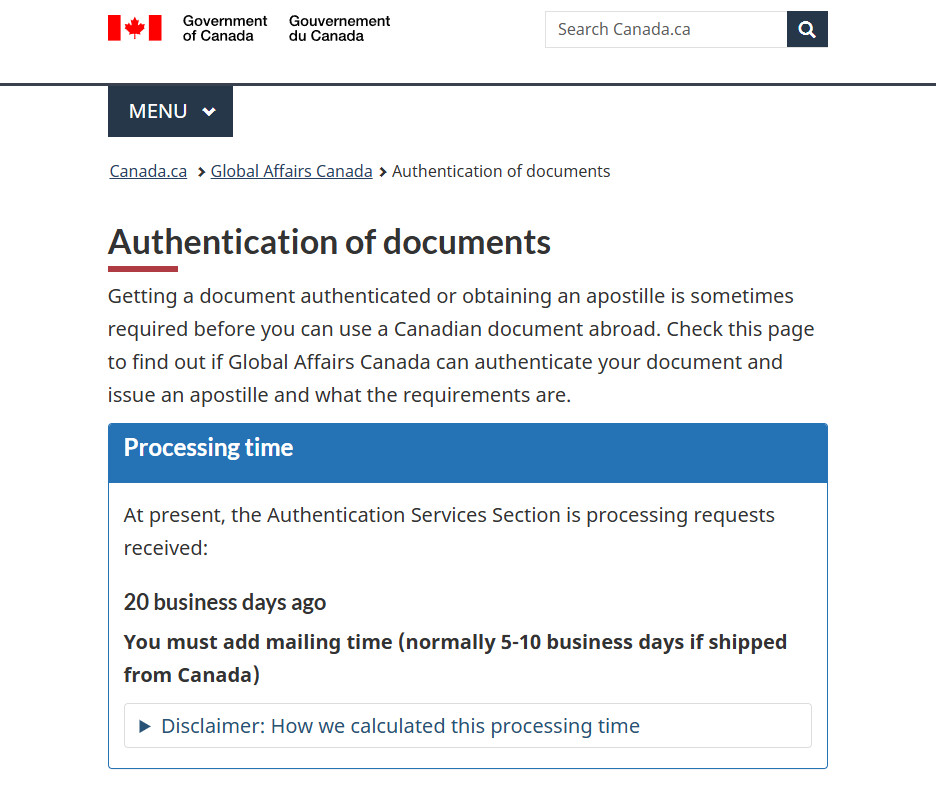
Once you receive your RCMP Criminal Record Check, you must get it authenticated with an apostille through Global Affairs Canada.
Cost: Free
Processing Time: Variable (20 business days) + mailing time (5 ~ 10 business days)
Steps to Get a Notarized and Apostilled Bachelor's Degree
You must submit a notarized copy of your Bachelor’s degree before it can be apostilled. Competent authorities in the following provinces are responsible for issuing apostilles for documents issued or notarized in their respective provinces.
|
Competent Authorities:
If your province does not have a apostilling authority, please use the Global Affairs Canada apostille and get the national apostille for both your degree and criminal check documents. |
To obtain a notarized and apostilled Bachelor's degree, there are two main steps:
- Get a Certified Copy of Your Original Diploma
- (Notarized by a Notary Public)
- Apostille a Copy of Your Diploma
1. Get a Certified Copy of Your Original Diploma
Option 1: Get a Certified Copy from the University
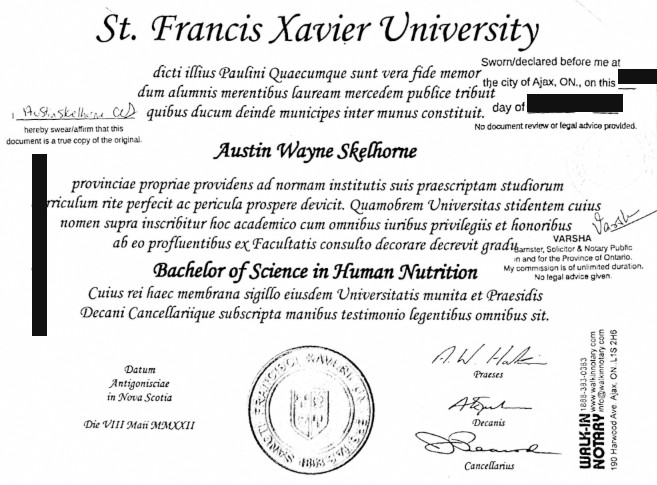
You can ask for a certified copy of your degree from your university, which means the university will notarize a copy of your diploma through a local notary public. Your diploma should have a notary stamp or seal if it's properly notarized.
Option 2: Notarize a Photocopy through a Notary Public
Some universities may refuse to issue duplicate diplomas and may only offer a replacement diploma. In this case, you must photocopy your diploma and get it notarized through a notary public.
2. Apostille a Copy of Your Diploma
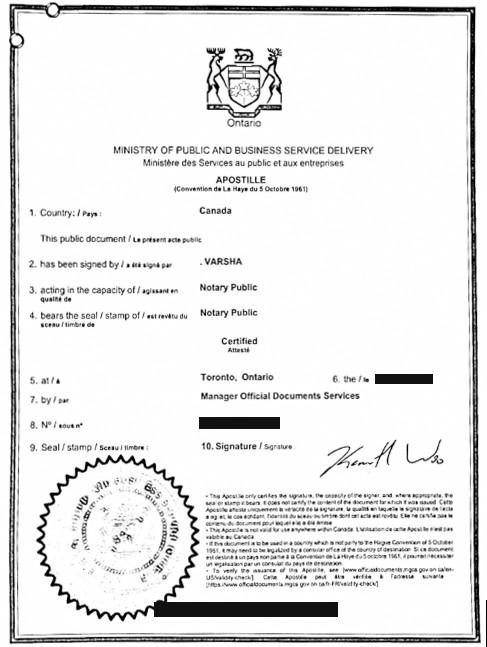
Where you send your diploma depends on which province it was notarized in.
If your diploma was notarized in:
- Alberta (Ministry of Justice of Alberta)
- Ontario (Ontario Ministry of Public and Business Service Delivery and Procurement)
- Saskatchewan (Ministry of Justice and Attorney General of Saskatchewan)
Send it to the provincial apostille authority, regardless of where the university diploma was originally issued.
If your diploma was notarized in:
- British Columbia (Ministry of the Attorney General of British Columbia)
- Quebec (Quebec Ministry of Justice)
Their competent authorities can only apostille it if the original diploma was issued in their province.
For all other provinces/territories, send your notarized diploma to Global Affairs Canada (Ottawa):
- Manitoba, New Brunswick, Newfoundland and Labrador, Northwest Territories, Nova Scotia, Nunavut, Prince Edward Island, and Yukon
Cost: Free
Processing Time: Variable (20 business days) + mailing time (5 ~ 10 business days)
FAQ
Q: How long does the entire process take?
|
Processing times depend largely on when you submit your documents, especially during periods of high demand, and on the competent authorities.
|
Q: Can I send the original diploma?
|
In theory, you can, but we do not recommend it. You will not receive the diploma back once you send it to your school. Always use a copy of your Bachelor's degree. |
Q: I graduated from a Canadian university but am not a Canadian citizen. Do I need to apostille or notarize my diploma in Canada?
|
Yes. Even if you are not a Canadian citizen, documents issued by a Canadian school must be notarized and apostilled in Canada to be recognized abroad. |
Q: I have a Master's degree. Do I also need to get it notarized and apostilled?
|
Unless requested by the school, you do not have to get your Master's degree notarized and apostilled. A Bachelor's degree will suffice if it was issued within one of the seven designated native English-speaking countries (the U.S., U.K., Canada, South Africa, Australia, Ireland, and New Zealand). |
Q: I have a teaching certificate (TEFL, TESOL, CELTA, etc.). Do I also need to get it notarized and apostilled?
|
Unless requested by the school, you do not. For an E-2-1 visa, a teaching certificate is not required. |
Not from Canada? Find out how to apostille and notarize your documents
TAGS
Share

Embark Recruiting Blogs
Embark Recruiting
As former native English teachers in Korea, we know exactly what it’s like to navigate teaching abroad. That’s why we’re committed to increasing transparency in schools and improving Korea’s ESL teaching industry. At Embark Recruiting, we provide full support to help you succeed. Our blogs offer guidance, tips, and insider knowledge for teaching in Korea.