| Note that through out this article, the Ministry of Employment and Labour is referred to as: MoEL, MoL and Ministry of Labour. They are all the same, governmental body.
An E-Petition in Korean is: 민원신청 / civil petition system |
Disclaimer: This is entirely a case-by-case procedure. The information below is a generalised explaination of the process. In you are ever in doubt, please speak to a lawyer.
Common Reasons to Report an Academy or School:
The most common reasons for teachers wanting to report their schools are as follows:
1. late or missed salary payments
2. Overtime work not being paid
3. Schools not honouring breaktimes
4. Schools not paying all four insurances (you can check this by calling NHIS, they can also tell you whether you are registered as 'freelance' or as an 'employee').
How to File a Complaint (Step-by-Step)
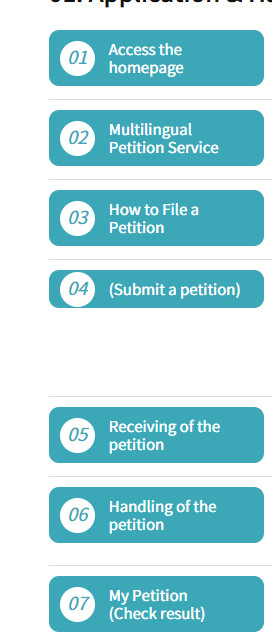
In order to get advice surrounding your working environment and concerns, you can submit a form using the Ministry of Labour's website.
1. File an E-Petition
Please note that the petition procedure is different for foreigners, compared to Koreans.
2. Once you have submitted the petition, it will be forwarded to the relevant department in the relevant provincial government.
For example, if your school is in Suwon, you will be contacted by Suwon's Ministry of Labour. Please note that this representative will most likely only speak Korean so you are free to converse with them via text message or email to make the translation quicker.
3. Once your petition has been filed and the Ministry of Labour has assigned you a representative, then you will discuss with that representative how you would like to proceed; do you want the school to be contacted or would you like to talk to them yourself first?
| Bear in mind that even if you have submitted the petition 'anonymously', schools are most likely able to deduce who submitted the complaint. |
Evidence
Before submitting your petition to the MoEL, please collate all the evidence possible for your case. As an example, when I reported my school, it was because they hadn't given us 11 days holiday and was refusing to give me my severance although I had worked for more than a year.
First make sure you have actually given the school your resignation letter or a letter of grievance, on the date that is stated at the top of the letter and that it includes details such as your full name, place of employment, it being addressed to your director/employer directly and your signature at the bottom. This letter can be in English or Korean and do not need to state the reasons why you want to leave. Then discuss with the school whether they will give you a letter of release; you can voice record or use text messages as evidence that the school 'verbally agreed' to giving you a Letter of Release.
*Please note that the schools legally do not need to give you a Letter of Release if you decide to leave, so do conduct yourself in a way so you can depart on good terms.
When I reported my school, I first organised a timeline of what was said with dates and the relevant evidence to back up my claims.
Example Case Timeline:
1st March: I told my school I would be leaving on the 30th March (resignation letter dated, signed by both parties attached)
3rd March: My director and I had a meeting and they said they are withholding my severance due to the fact they had not found my replacement and I would have to pay 'recruitment fees'. (I attached the voice recording of that meeting).
6th March: I reported my school to the Ministry of Labour with all the relevant evidence and a transcript of the previous conversation.
15th March: I was contacted by a MoEL representative for Ilsan and explained to them that I would like them to call the school to explain (in Korean) that I had reported them for violations of Korean Labour Act.
16th March: The school was called and the agent told me that this conversation had taken place (they would not tell me the content of the conversation)
19th March: MoEL said that if my severance was not paid two weeks after my last day (e.g. in this case, 14th April), then they would issue a warning to the school that they would be investigated and fined if it was not paid within 24 hours.
14th April: My school paid my severance and the money owed for the holidays I was 'not allowed to take' (in this case, 3 days worth of 'overtime' work over the 1 year I had worked there). The case was then dropped by the MoEL after I provided evidence that they had paid my severance.
Visa Considerations (E2 vs F-series)
The situation for F-series visa holders is very different from E2 holders.
At this time, I was an F6 visa holder, so I did not require a letter of release. However, if you hold an E2 visa, you would need to tell the officer during the initial conversation that you require a letter of release to leave the school and the school is refusing to give you one (for whatever reason the school had stated- it is best to get your school refusing and their reason in writing or as a voice recording). If the school is found to be in violation of labor laws, MOEL may provide documentation supporting your case, which can sometimes be used with immigration as an alternative to a Letter of Release. Ultimately, it is immigration who decide visa transfer eligibility. This letter, along with other documents, will be given to immigration once you have signed a new contract.
If you are seen to have given false evidence or not given sufficient evidence at any point of this process, the government can dismiss your case and you will still be employed at the school (if the school has not fired you). Even under these circumstances, the school needs to give you 30 days notice of employment termination (if after 3 months probationary period. If it is during the first 3 months, the school can legally fire you anytime without notice). If you have committed fraud or falsified evidence to a large extent, your visa can be put at risk.
Before filing your petition, we would suggest talking with an employment and labour lawyer to discuss the details of your case. You can also read the Labour Law for yourself (in English) here.
Important things to note:
|
TAGS
Share

Embark Recruiting Blogs
Embark Recruiting
As former native English teachers in Korea, we know exactly what it’s like to navigate teaching abroad. That’s why we’re committed to increasing transparency in schools and improving Korea’s ESL teaching industry. At Embark Recruiting, we provide full support to help you succeed. Our blogs offer guidance, tips, and insider knowledge for teaching in Korea.