Maps
In South Korea, navigation apps are essential for getting around efficiently, whether you’re walking, driving, or using public transportation. Two of the most widely used mapping services are Kakao Maps and Naver Maps, both offering detailed maps, real-time traffic updates, and information about local businesses and landmarks.
Kakao Maps is a popular mapping and navigation app in South Korea, developed by Kakao. It offers detailed maps, real-time traffic updates, public transportation routes, and turn-by-turn navigation. Users can search for businesses, restaurants, and landmarks, making it easy to explore cities or find the quickest route to any destination. Its user-friendly interface is especially popular among locals and visitors alike.
Naver Maps, created by Naver, South Korea’s largest search portal, is another top mapping service. It provides detailed maps, driving and public transit directions, and real-time traffic information. Naver Maps also offers walking navigation, street view, and points of interest, including restaurants, shops, and tourist spots. It’s widely trusted for its accuracy and comprehensive local information.
T-money and Transportation in Korea
Getting around Korea is convenient and efficient thanks to its extensive public transportation system, including buses, subways, and taxis. One of the most useful tools for navigating this system is T-money, a rechargeable transportation card.
What is T-money?
T-money is a smart card that you can use to pay for public transportation across Korea. Instead of buying separate tickets for each ride, you simply tap your T-money card when you enter and exit buses or subway stations. The fare is automatically deducted, and you can reload the card at convenience stores, subway stations, or even online.
Where can you use T-money?
-
Subways: All major cities, including Seoul, Busan, Daegu, and Incheon, have subway systems that accept T-money.
-
Buses: Both city and intercity buses accept T-money. Just tap when you board and exit.
-
Taxis: Many taxis in Korea accept T-money as a payment option.
-
Other services: Some convenience stores, vending machines, and taxis also accept T-money.
Transportation in Korea
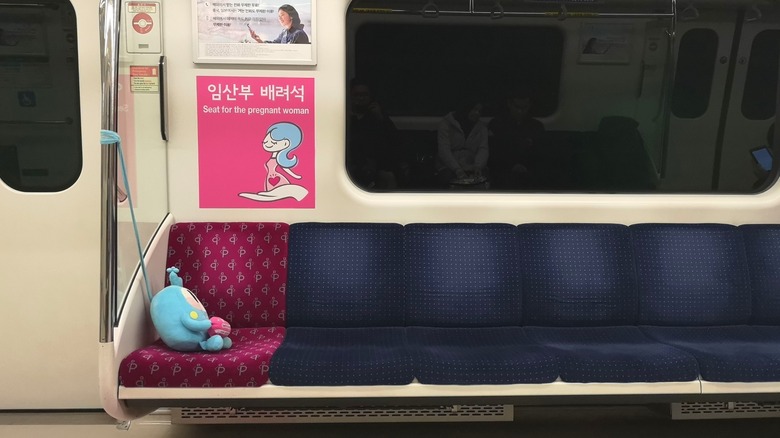
Subway: Fast, reliable, and clean, subways are the most popular way to travel within cities. Major lines are color-coded and well-marked in both Korean and English. In both buses and subways, please do not sit in the pink seats or the seats at the end of each carriage; they are reserved for less-abled people and pregnant women and there is an unwritten social rule that you can’t sit there.
Buses: Local buses cover areas that subways don’t reach. Bus types are usually color-coded (blue, green, yellow, red) depending on whether they are city, local, or express buses.
Taxis: Taxis are widely available and relatively affordable. You can pay by cash, T-money, or card. Some apps like KakaoTaxi make it easy to book rides.
Trains: For intercity travel, Korea has KTX high-speed trains, regular trains, and express trains, which connect cities quickly and efficiently.
KTX (Korea Train eXpress)
KTX is Korea’s high-speed train, similar to Japan’s Shinkansen or France’s TGV. It connects major cities across the country at speeds up to 300 km/h (186 mph), making it the fastest way to travel long distances in Korea.
Key points about KTX:
-
Coverage: Connects Seoul with cities like Busan, Daegu, Gwangju, and Mokpo.
-
Travel time: For example, Seoul to Busan takes about 2.5 to 3 hours.
-
Comfort: Trains have reserved seating, clean restrooms, and onboard services like snack carts or Wi-Fi.
-
Booking: Tickets can be bought online, at train stations, or via apps.
KTX is ideal if you want to travel quickly and comfortably between cities.
SRT (Super Rapid eXpress)
SRT is a regional high-speed train that mainly serves shorter or mid-distance routes. It’s faster than regular trains but generally slower than KTX. SRT is designed for regional connections and is perfect for commuters or travelers between smaller cities.
Key points about SRT:
Coverage: Connects nearby cities within a province, such as Daegu–Gyeongju or Cheongju–Sejong.
Speed: Faster than local or express trains but slower than KTX.
Usage: Good for travelers who want a quick regional connection without paying the KTX fare.
Usefuk Links
T Money’s Website and Usage Guide
Subway websites for the major cities
*Look at the unlimited pass in Seoul (Climate Card):
-
Busan – Public Transportation page
-
Daegu – English transport page
-
Daejeon – English portal for the city
Bus websites for each major city
-
Seoul: Seoul Metropolitan Government
-
includes bus usage guide.
-
-
Busan:
Busan Metropolitan City -
Daegu: Daegu Metropolitan Government
-
Daejeon: Daejeon Metropolitan City
TAGS
Share
Embark Recruiting Blogs
Embark Recruiting
As former native English teachers in Korea, we know exactly what it’s like to navigate teaching abroad. That’s why we’re committed to increasing transparency in schools and improving Korea’s ESL teaching industry. At Embark Recruiting, we provide full support to help you succeed. Our blogs offer guidance, tips, and insider knowledge for teaching in Korea.